Table of Contents
Yoga for Tight Hips From Sitting All Day: A 5-Minute Stretch Routine
You stand up after a long stretch at your desk and your hips feel locked. Walking to the kitchen takes a few steps before anything loosens up. If you have looked up yoga for tight hips from sitting all day because your body feels stiff by mid-afternoon, you are not imagining it. This guide explains why desk work tightens your hips, then walks you through a 5-minute routine you can do next to your chair.
This article is for general education and is not medical advice. Talk to a doctor or physical therapist before starting new stretches, especially if you have a hip or back condition.
Why Are My Hips So Tight After Sitting All Day?
The short answer is your hip flexors, especially the iliopsoas muscle, sit in a shortened position for hours at a time. According to the Hospital for Special Surgery, sitting compresses the hip flexors, causing them to shorten and tighten over time. Your hip flexors run from your lower spine and pelvis down to the top of your thigh bone.
When you sit, that muscle group stays folded for hours. It never gets a chance to lengthen back out. Do that five days a week, year after year, and the muscle adapts to its shortened resting length.
This is one of the most common reasons people search for hip opening stretches for desk workers. The tightness is not just in your imagination. It is a muscle that has learned to stay short because that is the position it holds most of the day.
That single stretch is a starting point, though. It points to a bigger question: why are my hips so tight after sitting all day?
The Link Between Tight Hips and Anterior Pelvic Tilt
Tight hip flexors do not stay isolated in the front of your hip. They can pull on your pelvis and change how you stand. When the hip flexors stay short, they may tilt the top of your pelvis forward, a pattern often called anterior pelvic tilt.
Weak core and glute muscles tend to show up alongside this pattern, because those muscles are supposed to help hold the pelvis level. Together, tight hip flexors and underused glutes and abs are commonly discussed as part of stretches to fix anterior pelvic tilt from sitting.
It is worth being honest about the science here. Mayo Clinic notes that research on how much stretching actually improves flexibility and posture is mixed. Some studies show benefits, others show smaller effects than people expect.
That does not mean stretching is pointless. It means the honest framing is that stretching may ease tightness and support better positioning. It does not promise to fix posture problems built up over years of sitting.
Your 5-Minute Hip-Opening Stretch Routine for Desk Workers
This routine takes about five minutes and needs nothing but a mat, a towel, or a carpeted floor. It is a simple way to practice yoga for tight hips from sitting all day, built for healthy adults without a diagnosed hip condition.
Before you start, walk in place or march your knees up for thirty seconds to warm up lightly. Breathe slowly through each stretch. Stop at the point where you feel gentle tension, never at pain. Per Mayo Clinic’s guidance, hold each stretch for about 30 seconds and avoid bouncing.
Kneeling Hip Flexor Stretch
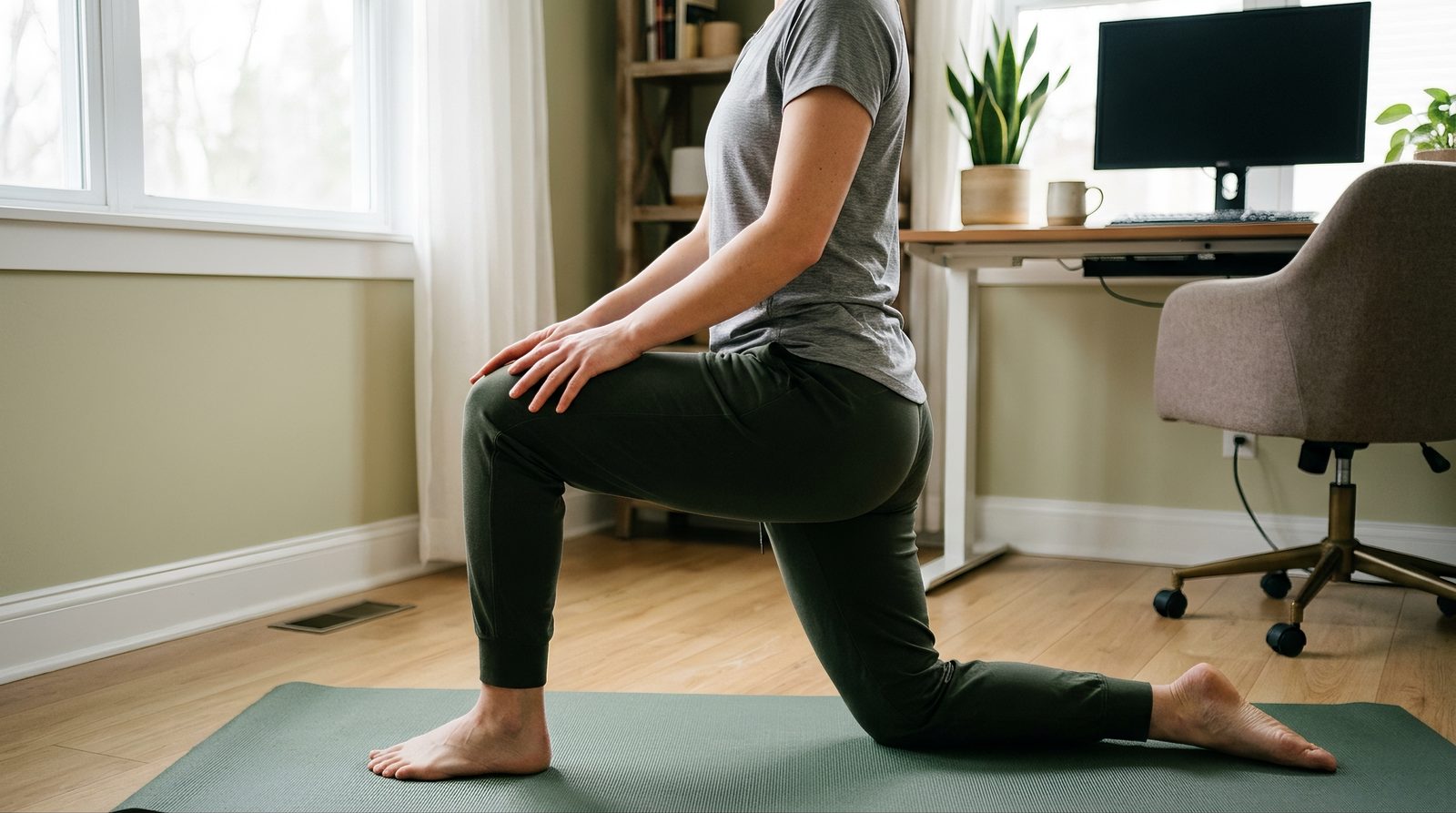
Kneel on your right knee with your left foot planted in front, knee bent at roughly 90 degrees. Tuck your pelvis slightly and press your hips forward until you feel a stretch along the front of your right hip. Keep your torso upright instead of leaning forward from the waist. Hold for 30 seconds, then switch sides. This move is a common answer to how to loosen tight hips from sitting at a desk. It directly targets the iliopsoas muscle.
Figure 4 Stretch (Seated or Reclined)
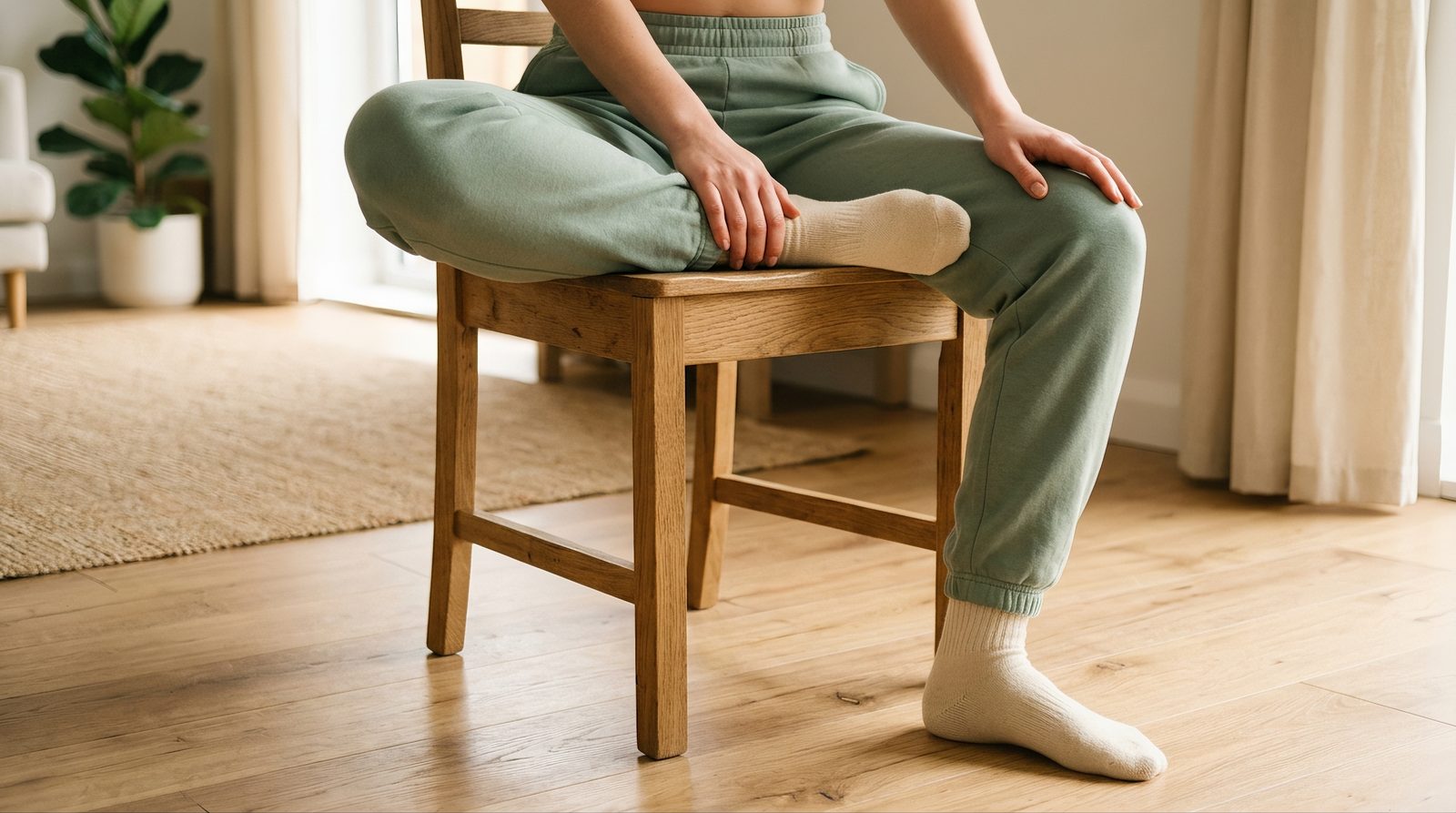
Sit tall in your chair, or lie on your back on a mat. Cross your right ankle over your left knee, making a number 4 shape with your legs. Gently press your right knee away from you while keeping your ankle relaxed, not flexed hard against the shin. You should feel this along the outside of your right hip and glute. Hold for 30 seconds, then switch. This move is a reliable figure 4 stretch for hip tightness because it opens the outer hip rotators that sitting also compresses.
Pigeon Pose: A Caution and a Gentler Modification
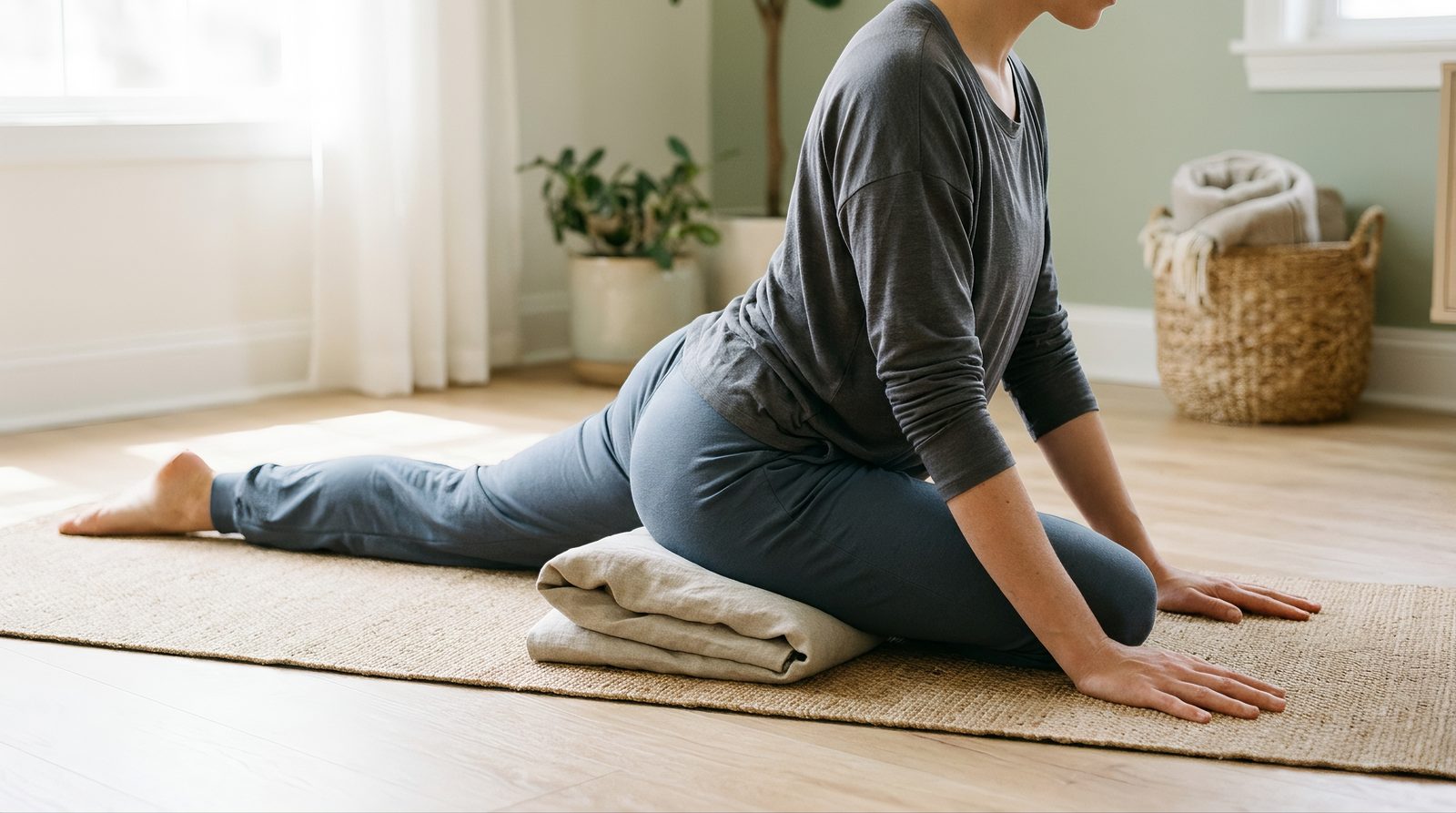
Pigeon pose is one of the most searched hip stretches, and also one of the most commonly over-forced. Healthline points out that many people push their hips too far into this shape. That can strain the knee and hip joint instead of gently opening them.
Start from hands and knees. Bring your right knee toward your right wrist and angle your right shin across the mat, then extend your left leg straight behind you. If your right hip does not comfortably reach the floor, place a folded cushion or towel under that hip for support. Ease into the position slowly and stop well before any pinching feeling. Hold for 20 to 30 seconds per side, using the cushion the whole time if you need it.
Seated Butterfly Forward Fold
Sit on the floor or the edge of your chair, if your chair allows it, and bring the soles of your feet together with knees falling open to the sides. Sit tall first, then hinge forward slightly from your hips, letting your head relax. Keep your back long rather than rounding through your shoulders. Hold for 30 seconds as a gentle closer for the whole routine.
Why Tight Hip Flexors May Turn Off Your Glutes (And What That Means for You)
You may have heard that tight hip flexors turn off your glutes, sometimes described as one muscle shutting down because another is too tight. This idea is often called reciprocal inhibition, and it deserves a careful, honest explanation.
Physical therapist Mike Reinold has written that this concept is not settled science. As he explains, the theory dates back to clinical observations from Janda in the 1980s. Reinold notes there is not much direct research confirming a strong link between tight hip flexors and weak glutes. Some clinicians theorize the connection matters, while others stay more cautious about how much it really explains.
What this means for you is simple. Tight hip flexors and underactive glutes are often present together in people who sit a lot, but stretching alone addresses only half the picture. Loosening a tight muscle does not automatically strengthen the muscle it may be affecting.
If your main goal is mobility and day-to-day comfort, the stretches above are a good place to start. But stretching alone will not build strength in glutes that may have gone underused from years of sitting. That is a separate project from flexibility work. For readers who want to explore that path, our evidence-based review of the Unlock Your Glutes program looks at what the program claims. It also covers what the evidence supports and where it runs thin.
Common Mistakes When Stretching Tight Hips
A few habits can undercut this kind of routine before it has a chance to help.
Over-forcing pigeon pose. Pushing your hip toward the floor before it is ready is the most common mistake with this stretch. That is the reason a cushion modification exists in the first place.
Stretching without ever strengthening. Static stretching alone rarely fixes a posture pattern built from hours of underused glutes and core. Mobility and strength work best together, not as substitutes for each other.
Bouncing into a stretch. Ballistic, bouncy movements increase the risk of strain compared to easing in slowly and holding still.
Expecting one session to last. A single five-minute routine will not undo eight hours of sitting for good. Many desk workers find they need to repeat these stretches daily, or take standing breaks through the workday, to notice a lasting difference.
When to See a Professional First (Safety and Scope)
This routine is meant for healthy adults dealing with ordinary stiffness from sitting, not for diagnosed joint problems. Stop and check in with a professional if you notice any of the following.
- Clicking, catching, or locking in the hip joint during movement
- Pain that does not improve after a few weeks of gentle stretching
- Pain sharp enough that you cannot comfortably bear weight on that leg
- Pain that radiates down your leg rather than staying in your hip
These signs can point to something beyond ordinary tightness. The Cleveland Clinic lists a clicking or popping feeling in the hip, along with pain or stiffness that does not get better within a few weeks, as reasons to see a healthcare provider. Those signs can point to a hip labral tear rather than simple stiffness.
Talk with a doctor or physical therapist before trying this routine if you have hip osteoarthritis, sciatica with leg pain, a recent hip surgery, or pregnancy-related pelvic pain. Those situations need guidance specific to your case, not a general desk-worker routine.
Frequently Asked Questions
How often should I do this hip stretch routine? Many desk workers find daily repetition, even in short sessions, works better than one long stretch a week. Consistency tends to matter more than duration for easing day-to-day stiffness.
Can yoga for tight hips from sitting all day fix my posture? Stretching may ease tightness and support more comfortable positioning. Posture built up over years of sitting usually needs strength work too, not stretching alone.
Is it normal for one side to feel tighter than the other? Uneven tightness is common, especially if you tend to cross the same leg or lean toward one side at your desk. Give the tighter side a little extra attention within your comfortable range.
Should stretching ever hurt? No. Stop at gentle tension, not pain. Sharp, pinching, or radiating pain is a signal to stop and check with a professional rather than push through.
Do I need a yoga mat for this routine? A mat helps with comfort on the kneeling and floor stretches. A carpeted floor or folded towel works fine if you do not have one nearby.
Leave a Reply