Table of Contents
How to Teach Yourself Piano as an Adult Beginner
Last updated: July 2026
You finally bought the keyboard, or you are eyeing one, and now you are wondering if you are too old to actually get anywhere with it. That worry is common, and it is usually wrong. Adults bring reading skills, focus, and the patience to fix mistakes that young kids often do not have yet, and those traits matter more than raw age. Learning how to teach yourself piano as an adult beginner is less about talent and more about building a routine you can actually stick to. This guide walks through how much to practice, a sample weekly schedule, and the mistakes that quietly slow most self-taught adults down.
Key Takeaways
- It’s not too late to start piano as an adult. Adults can read, focus, and self-correct in ways young children often can’t, which tends to speed up the early stages.
- Two short sessions of about 10 to 15 minutes each usually build skill faster than one long session, especially in the first few months.
- Consistency beats duration. Playing 15 to 20 minutes most days shows more progress than one 60-minute session once a week.
- Many beginners can play a simple, recognizable song within the first few weeks of steady practice, but reaching an intermediate level realistically takes years, not months.
- The habits that slow adults down most are skipping the metronome, avoiding hands-together practice, and comparing progress to prodigies online.
How Much Should You Practice Piano Each Day as a Beginner?
Most beginners do well with 15 to 30 minutes a day, split into two shorter sessions rather than one long block. That amount is enough to build finger memory without burning you out. More matters less than showing up consistently, especially in your first few months.
According to Musicnotes, around 10 to 15 minutes is often enough at the earliest stage, and two 15-minute sessions in a day tend to produce better results than one 30-minute block for beginners. That matches what most piano teachers tell adult students. Short, focused sessions keep your hands fresh and your attention sharp.
If you only have 10 minutes some days, that still counts. The goal at this stage is building a habit, not logging hours. A missed long session hurts less than a missed short one, because the short one is the one that keeps the habit alive.
As you get further into your first year, you can stretch sessions to 30 or 40 minutes if your schedule allows it. But there is no need to force that early. Adult beginners who try to jump straight into hour-long sessions often quit within a month because the sessions feel like a chore instead of a habit.
Why Consistency Beats Long, Infrequent Sessions
A single 60-minute session on a Sunday will not build the same skill as four 15-minute sessions spread across the week. Piano is a motor skill, and motor skills need repeated, spaced practice to move into muscle memory. Cramming one long session works about as well as cramming for a language test the night before.
This matters most for busy adults who feel like they do not have “enough” time to practice. You do not need a free hour. You need five separate 15-minute windows, and most weeks already have them.
Look at your actual day instead of your ideal day. A keyboard by the coffee maker gets played during the kettle boil. A keyboard near your desk gets a few minutes during a lunch break. The trick is removing the setup time between deciding to practice and actually playing.
Treat practice like brushing your teeth rather than like a gym trip you have to plan around. You do not need motivation to brush your teeth. You just do it because it is part of the day. Piano practice can work the same way once it is attached to an existing routine, like right after breakfast or right before you check your phone in the evening.
If a full week gets disrupted by travel or work, do not try to make it up with one long weekend session. Just resume the short daily pattern the next day. Consistency restarts faster than it rebuilds from a big catch-up attempt.
A Sample Weekly Practice Routine for Adult Beginners
A practice session works best when it follows a simple structure every time, so you are not deciding what to do while you are supposed to be playing. A basic order is warm-up, technique work, your current piece hands separately, the same piece hands together, and then something you just enjoy playing.
Warming up for two or three minutes with simple five-finger patterns wakes up your hands before you touch anything technical. Technique work comes next, usually five to eight minutes on scales, chords, or whatever exercise your method book assigns. Then move into your current piece, starting with each hand alone before combining them. Finish with a song you already know and like, even if it is simple. That last step is what keeps you coming back the next day.
Here is a sample week built around 15 to 20 minute sessions most days, with one rest day and one slightly longer session on the weekend.
| Day | Focus |
|---|---|
| Monday | Warm-up, scales, current piece hands separately |
| Tuesday | Warm-up, chords, current piece hands together (slow tempo) |
| Wednesday | Rest day or 5-minute light review |
| Thursday | Warm-up, technique drill, current piece hands together |
| Friday | Review current piece, play a favorite song for fun |
| Saturday | Longer session (30-40 min): new section of current piece plus sight-reading |
| Sunday | Free play, review the week, pick next week’s focus |
You do not need to follow this table exactly. The structure matters more than the specific days. What counts is that each session has a warm-up, a technique element, hands-separate-then-together work on your current piece, and a moment of just playing for enjoyment.
Common Mistakes Adult Beginners Make (and How to Fix Them)
Self-taught adult beginners tend to repeat the same handful of mistakes, and most of them are fixable once you notice them.
Skipping the metronome. It feels awkward at first, so many beginners avoid it entirely. Without it, tempo drifts and you practice timing errors into the piece. Start the metronome slower than feels natural and only speed up once a section is clean.
Playing too fast, too soon. Rushing through a new piece at full speed locks in fingering mistakes. Play new material slowly enough that you never hit a wrong note, then increase speed gradually over several days.
Skipping the warm-up. Jumping straight into the hardest part of a piece with cold hands leads to tension and sloppy technique. A short warm-up costs two minutes and saves frustration later.
Avoiding hands-together practice. Hands-separate work is easier, so it is tempting to stay there. But hands-together is where the real coordination skill gets built, and putting it off just delays the hard part.
Neglecting the left hand. Most method books put more melody in the right hand, so the left hand quietly falls behind. Give it deliberate extra attention in your technique section.
Inconsistent schedule. Practicing five days one week and zero days the next resets progress every time. A shorter, steadier schedule beats a sporadic ambitious one.
Practicing mistakes into muscle memory. Playing through an error repeatedly without stopping to fix it teaches your hands the wrong version. Stop, isolate the trouble spot, and repeat it correctly a few times before moving on.
How to Stay Motivated When Progress Feels Slow
Motivation dips are normal, especially around week six or seven, when the early excitement fades and progress feels slower. The fix is usually structural, not emotional. Build small wins and variety into your routine instead of waiting to feel inspired.
Play songs you actually like, not just method book exercises. A simplified arrangement of a song you love will keep you at the bench longer than another scale drill. Mix a few minutes of “fun playing” into every session, even during technical weeks.
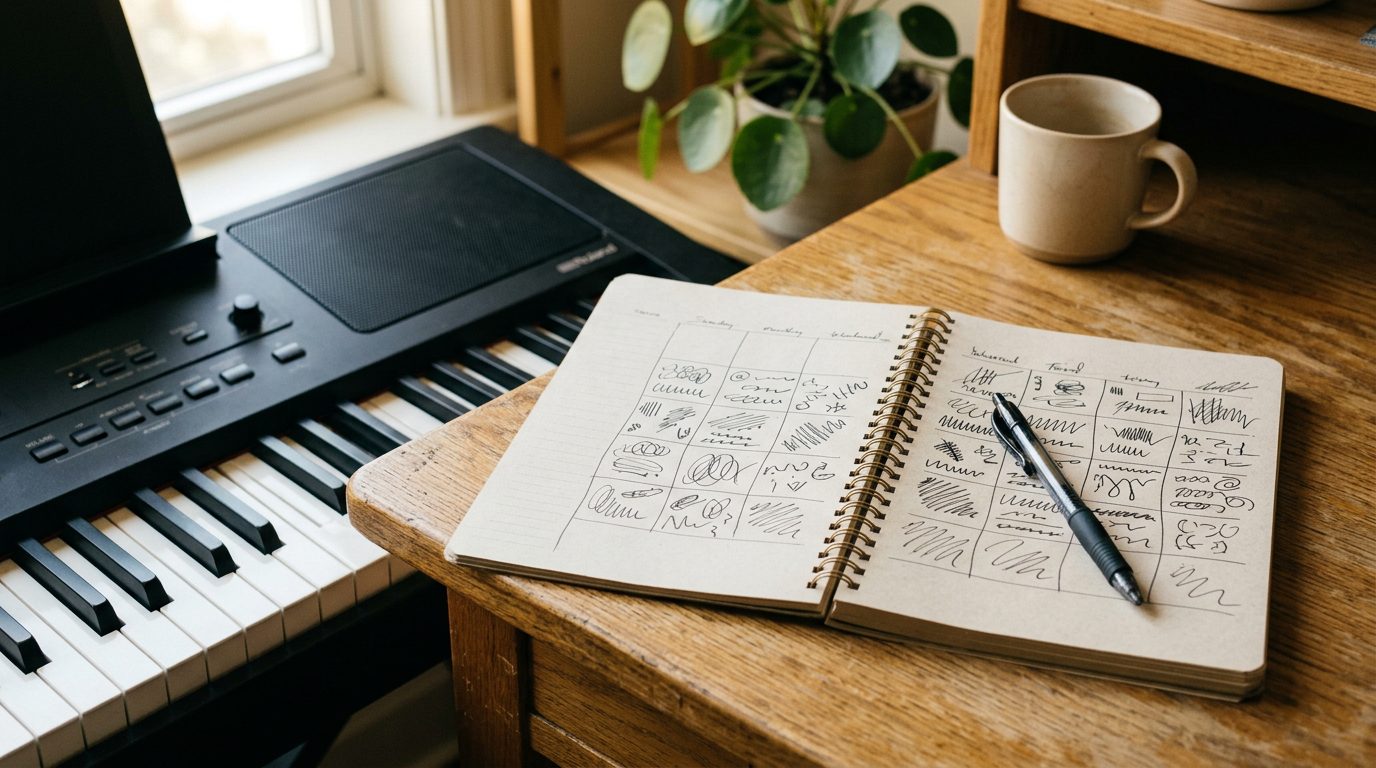
Track small wins instead of big milestones. Write down when a tricky measure finally clicks, or when a piece you struggled with last month feels easy now. Progress in piano is gradual, so a practice log makes it visible when it would otherwise feel invisible.
Set micro-goals instead of vague ones. “Play the first four measures hands together by Friday” is easier to hit than “get better at piano this month.” Small, specific targets give you something to actually check off.
Avoid comparing your progress to videos of prodigies or professionals online. Those clips show years of accumulated practice condensed into a few seconds. Comparing week six of your own practice to someone else’s highlight reel is not a fair measure of how you are doing.
How Long Does It Really Take to Learn Piano as an Adult?
Most adult beginners can play a simple, recognizable song within the first few weeks of steady practice, but reaching a genuinely intermediate level takes years of consistent effort, not months. There is no shortcut around the accumulated hours that build real fluency.
A survey of more than 1,100 pianists (1,159 respondents) by Pianote found that reaching an intermediate level typically takes about 4 to 5 years of consistent practice. That number reflects self-reported experience across a wide range of practice habits, not a guarantee for any individual learner. Someone practicing 20 minutes daily will move differently than someone practicing an hour a day, and both are normal paths.
Early progress usually feels faster than later progress. The first simple song can come together within a few weeks, and a handful of easy pieces often follow within the first several months. The plateau that shows up later, where improvement feels slower even though you are still practicing, is a normal part of the process rather than a sign something is wrong.
Think of the timeline in stages instead of one long countdown. The first few months are about basic coordination and reading. The next year or two build repertoire and technique. Intermediate skill, the kind that lets you tackle moderately complex pieces with confidence, tends to arrive somewhere in that multi-year range the Pianote survey describes.
Want More Structure Than Self-Teaching?
Self-teaching works well for a lot of adults, especially with a clear routine and realistic expectations. But it has limits. Without any outside structure, it is easy to misjudge your own technique or stay stuck on a habit you cannot hear as a problem yourself.
Some adult beginners eventually look for a guided, structured course instead of piecing everything together on their own. Pianoforall is one option built around a chord-based approach rather than traditional notation-first lessons. For readers weighing whether that kind of structure is worth it, our review of Pianoforall looks at whether it holds up for adult beginners specifically.
Whether you stick with self-teaching or add a structured course later, the practice habits in this guide still apply. Routine and consistency matter more than which method you choose.
Frequently Asked Questions
Is it too late to learn piano as an adult? No, it is not too late. Adults often progress faster than young children in the early stages because they can read instructions, focus for longer stretches, and correct their own mistakes without needing constant supervision.
How long does it take to learn piano as an adult? A simple song is often playable within the first few weeks of steady practice, while reaching an intermediate level typically takes about 4 to 5 years of consistent effort, based on the Pianote survey of more than 1,100 pianists cited above. Individual timelines vary based on practice frequency and prior musical background.
How much should I practice piano each day as a beginner? Most beginners do well with 15 to 30 minutes a day, ideally split into two shorter sessions rather than one long one. Consistency across most days of the week matters more than the length of any single session.
Can you learn piano in your 50s? Yes, age in your 50s or beyond does not block meaningful progress on piano. What matters most is a steady practice routine, realistic pacing, and patience with the gradual nature of building a new motor skill.
What’s the best way to start learning piano on your own? The best way to start is with short, structured daily sessions that include a warm-up, technique work, and time on a piece you are learning. Pairing that routine with a beginner method book or app gives your practice direction from day one.
Leave a Reply